


If we were to break the big task of making a tictactoe game into smaller ones it would be
- Making the Board
- Taking options and replacing positions
- Finding out the victor/tie
Making the board
Making the board is simple enough by using some ideas of for loops and arrays we can make a simple looking board as such
#include <stdio.h>

int main(){
	// The board would consist of 3x3 characters
	char board[3][3] = {{'-', '-', '-'}, {'-', '-', '-'}, {'-', '-', '-'}};

	printf("Borad\n");
	for (int i = 0; i < 3; i++){
		for (int j = 0; j < 3; j++){
			printf(" %c |", board[i][j]); // Prints the character of with a border |
		};
		printf("\n"); // New line for the new row
	}
}
Output: Board: - | - | - | - | - | - | - | - | - |
- Using If conditions you can making it have the left border as well, Visually speaking a lot of things is possible with a lot more variety and much more appeal. But this is just to show how it can be operational
Taking inputs and making replacements
What we can do here is simply, replace the character at the x, y position as our characters are entirely within an array
#include <stdio.h>

int main(){

	char board[3][3] = {{'-', '-', '-'}, {'-', '-', '-'}, {'-', '-', '-'}};
	int loc;
	scanf("%d", &loc); // Implies the location
	int y = loc % 10;
	int x = loc / 10;

	board[x][y] = 'X'; // This would replace it with X no matter what
	printf("Borad\n");
	for (int i = 0; i < 3; i++){
		for (int j = 0; j < 3; j++){
			printf(" %c |", board[i][j]);
		};
		printf("\n");
	}
}
In order to keep track of
- If it should be X or O
- The game should end
We can declare a
selvariable which will simply keep track of how many selections we’ve done
- If
selis even It can be ‘X’ - Odd -> ‘O’
Furthermore to change the value of X and O, We can declare an opt variable to simply store what character we are on
#include <stdio.h>

int main(){

	char board[3][3] = {{'-', '-', '-'}, {'-', '-', '-'}, {'-', '-', '-'}};
	int loc, sel = 1; // As the first time selection will be 1st
	char opt = '-'; // Default value is null

	while (sel <= 9){ // A loop to keep asking locations

	scanf("%d", &loc);
	int y = loc % 10;
	int x = loc / 10;
	if (board[y][x] = '-'){ // Checks if the position hasn't already been picked
	if (sel % 2 == 0){ // switches between X and O as selection continues
	    opt = 'X';
	} else {
	    opt = 'O';
	}}

	board[x][y] = opt;
	printf("Borad\n");
	for (int i = 0; i < 3; i++){
		for (int j = 0; j < 3; j++){
			printf(" %c |", board[i][j]);
		};
		printf("\n");
	}
	sel++; // Increments the selections
	}
}
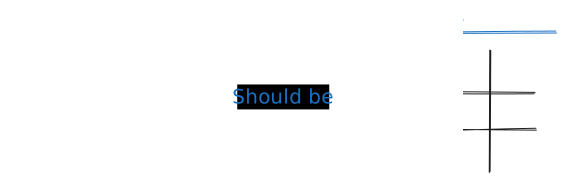
Now to handle an inconvenience issue, Currently, We are taking inputs x and y with respect to 0 as the initial value. But that isn’t what we usually do
 %%🖋 Edit in Excalidraw, and the dark exported image%%
We can do this by just taking such and such inputs and decrementing x and y by 1
	int y = loc % 10; // Taking x and y values starting from 1
	int x = loc / 10;
	x--;
	y--;
Like so
Winner or Not ?
This is where the idea becomes mildly interesting, Some things to keep in mind
- Check the victor when a location has been placed
- Check if the declared
optis same for specific portions
We can divide the victories into specific portions
-
Vertical
- Where the y axis (row) the same
- So keeping x of
loc, we can increment j (y value) from 0 to 2 to see if the vertical for that specific X position is the same 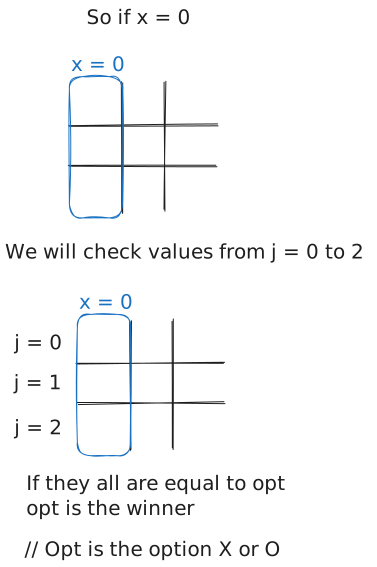 %%🖋 Edit in Excalidraw, and the dark exported image%%
- So keeping x of
- Where the y axis (row) the same
-
Horizontal
- Where the x axis (column) the same
- So keeping y of
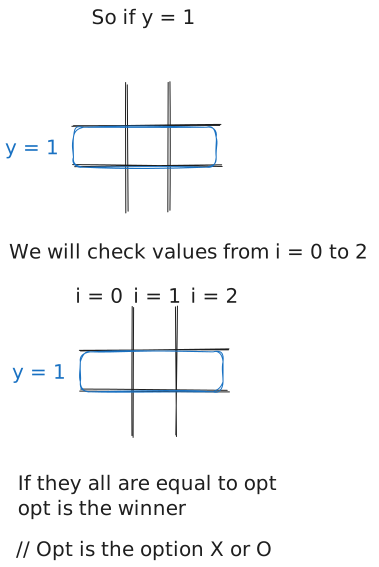
loc, we can increment i (x value) from 0 to 2 to see if the vertical for that specific Y position is the same
- So keeping y of
 %%🖋 Edit in Excalidraw, and the dark exported image%%
- Where the x axis (column) the same
-
Diagonal
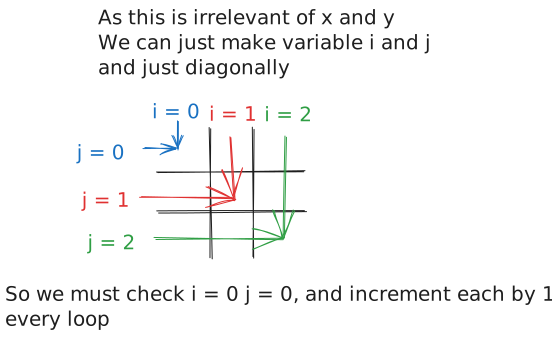
- Where the x++ and y— are the same
- No value from the
locwill be relevant
- No value from the
 %%🖋 Edit in Excalidraw, and the dark exported image%%
- Where the x++ and y— are the same
-
Anti-Diagonal
- Where the x++ and y++ are the same
- No value from the
locwill be relevant
- No value from the
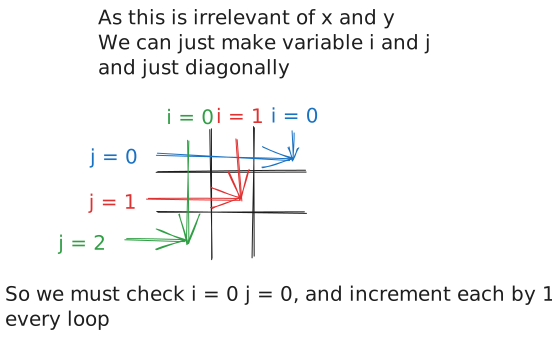 %%🖋 Edit in Excalidraw, and the dark exported image%%
- Where the x++ and y++ are the same


In terms of code it would look like this
	// Column

	for (int i = 0; i < 3; i++){
		if (board[x][i] != opt){
			break;
		} else if (i == 2) {
			printf("WIN WIN WIN %c", opt);
			win = 1;
		}
	}

	// Vertical
	for (int i = 0; i < 3; i++){
		if (board[i][y] != opt){
			break;
		} else if (i == 2){
			printf("Winnn %c", opt);
			win = 1;
		}
	}

	// Diagonal
	for(int i=0,j=0; i < 3; i++){
		if (board[i][j] != opt){
			break;
		} else if (i==2){
			printf("WINNN %c", opt);
			win = 1;
		}
		j++;
	}

	// Anti Diagonal
	for (int i = 0, j = 2; i < 3; i++){
		if (board[i][j] != opt){
			break;
		} else if (i == 2){
			printf("Winnnnnn %c", opt);
			win = 1;
		}
		j--;
	}
We can keep track of if a person won or not by simply having a int variable win and placing it in the condition of while loop, To function as long as it has a value of 0 (No victor yet)
The overall code for this would look something like this
#include <stdio.h>

int main(){
	char board[3][3] = {{'-', '-', '-'}, {'-', '-', '-'}, {'-', '-', '-'}};
	int sel = 1, loc;
	int win = 0;

	while (sel < 8 && win == 0){

	int loc;
	scanf("%d", &loc);
	char opt;
	int y = loc % 10;
	int x = loc / 10;
	x--;
	y--;

	if (board[x][y] == '-'){
		if (sel % 2 == 0){
			opt = 'X';
		} else {
			opt = 'O';
		}
	};

	board[x][y] = opt;

	// Board

	printf("Board \n");
	for (int i = 0; i < 3; i++){
		for (int j = 0; j < 3; j++){
			printf(" %c |", board[i][j]);
		}
		printf("\n");
	}

	// Column

	for (int i = 0; i < 3; i++){
		if (board[x][i] != opt){
			break;
		} else if (i == 2) {
			printf("WIN WIN WIN %c", opt);
			win = 1;
		}
	}

	// Vertical
	for (int i = 0; i < 3; i++){
		if (board[i][y] != opt){
			break;
		} else if (i == 2){
			printf("Winnn %c", opt);
			win = 1;
		}
	}

	// Diagonal
	for(int i=0,j=0; i < 3; i++){
		if (board[i][j] != opt){
			break;
		} else if (i==2){
			printf("WINNN %c", opt);
			win = 1;
		}
		j++;
	}

	// Anti Diagonal
	for (int i = 0, j = 2; i < 3; i++){
		if (board[i][j] != opt){
			break;
		} else if (i == 2){
			printf("Winnnnnn %c", opt);
			win = 1;
		}
		j--;
	}

	sel++;
	}
}
We can take this entire check, Place it in a function and then into the while loop, Making the overall code more elegant
But that requires some understanding from later on stuffs!